Showing posts with label solar system. Show all posts

Tuesday, 3 November 2020

Miranda: a moon of Uranus


Miranda is the innermost of the five moons of Uranus that were known purely from telescopic observations before space probes ventured in its direction. Images returned by the Voyager 2 probe in 1986 revealed a surprisingly complex world, with a mixture of heavily created and smooth terrain, separated by deep canyons and towering cliffs. The most impressive features are regions covered in parallel grooves, which are known as coronae.

It was originally thought that this small moon, with an average diameter of only 293 miles (472 km), had shattered completely at some point in the distant past and then reassembled. However, it is much more likely that Miranda followed a much more eccentric orbit at some stage in its history that it does today. This would have caused extreme gravitational tidal pressures on the moon, leading to alternate periods of melting and re-forming. Large areas of the crust would have subsided and new material welled up from inside the moon to replace them.

With Miranda’s orbit becoming more regular, the tidal pressures would have ceased, leaving the surface to freeze into its current configuration.

© John Welford

Monday, 6 July 2020

When will the Sun stop working?


The Sun is a massive nuclear fusion reactor that is converting hydrogen to helium and releasing vast quantities of energy as result. This means that eventually it will run out of fuel and cease producing energy. When that happens there will be no possibility of life continuing on any planet in the solar system. So how long have we got?


We’re all doomed!

All good things must come to an end, and that means that not only will every person, animal and plant currently alive have to “meet its maker” (however you might interpret that expression), but even the Sun itself will eventually die and cease to emit light and heat.

However, there is no need to panic! The Sun has been going strong for 4.6 billion years and will continue to do so for a long time yet.

What will happen, over the next few billion years, is that as the Sun’s nuclear fuel is gradually used up it will become both brighter and bigger - twice as bright and 50% larger.

Around five billion years from now all the hydrogen in the Sun will have been converted to helium and the nuclear fusion process will end. The core will shrink and the outer layers expand massively while at the same time becoming much cooler. The Sun will have become a red giant.

The diameter of the Sun will expand to such an extent that it will swallow up the inner planets, including Earth. However, life on this planet will have become impossible long before this point is reached – even if mankind has not committed collective suicide (on behalf of all living things) many millions of years before this happens.

Eventually the Sun’s outer layers will fade away into space, to leave only a small white dwarf star behind. If the Sun had been considerably more massive at the outset it would have run the risk of exploding as a supernova, but it was never anywhere close to being that category of star.

The total life of the Sun, from birth to death as a fading white dwarf, will have been about 11 billion years, of which the existence of humankind on Earth will have been an extremely small fraction.

At least – when it happens – nobody will be able to blame any President or Prime Minister of the “wrong” political persuasion for their lack of action in allowing the Sun to stop working!


© John Welford

Venus: Earth's fierce sister planet


Venus is the closest planet to Earth in terms of distances between orbits (about 41 million kilometres) and the two planets are quite similar in size, surface area, volume and mass. Venus is therefore sometimes dubbed Earth's sister planet.

However, the sisters have very different characteristics. For one thing, Venus rotates far more slowly than Earth, so that a day on Venus lasts longer than a Venusian year! It also rotates the other way round to Earth, so that the sun rises in the west and sets in the east.

However, the most important difference, and the main one that makes it impossible for life to exist there, or for manned missions ever to be contemplated, is that the surface temperature on Venus averages 450 degrees Celsius. Atmospheric pressure is also enormous, being 90 times as great as that on the surface of Earth.

The main reason for the huge surface temperature is the fact that the Venusian atmosphere consists of 96% carbon dioxide, thus causing the thick cloud cover of Venus to act like extremely efficient greenhouse glass. Temperatures on Venus are therefore 100 degrees hotter than on Mercury, which is closer to the sun by about 50 million kilometres.

It has often been said that Earth risks becoming another Venus if the proportion of greenhouse gases in the atmosphere is allowed to keep rising. However, with carbon dioxide currently representing 0.4% of Earth's atmosphere it clearly has a long way to go before reaching the Venusian level!


© John Welford

Sunday, 5 July 2020

Clues to life on Mars from the Atacama Desert


The idea that there might once have been living organisms on Mars is a fascinating one, and even more so is the notion that some form of very primitive life might still be there. However, clues as to where the evidence for past or present life could be found are coming from a very strange direction, namely studies of the Atacama Desert in Chile, South America.

The Atacama Desert is one of the driest places on Earth and thus offers a reasonably close parallel to conditions on Mars – or at least to Mars as it might have been in fairly recent geological time.

The point is that microbes – very simple life forms – can survive for many years in water-free environments and reactivate when water again becomes available. This has been shown to happen in the Atacama Desert, where microbes survive in a dormant state in salt crusts (see picture) that absorb any water that happens to be around. This need not even be liquid water, because salt can take water directly from the air.

The question is therefore whether similar conditions could exist on Mars, given that it is known that there was once abundant liquid water on the planet that could have given rise to salt deposits as it evaporated. Indeed, such deposits have been discovered in Mars’s southern uplands. Modern Mars is not totally devoid of water, although most of it exists as ice at the north polar cap and beneath the surface. There are also very small amounts of water vapour in the thin atmosphere of the planet.

Given the much drier conditions on Mars, it is conceivable that evolutionary processes might have worked differently than on Earth, such that lifeforms could have survived on Mars that would not have done so on Earth. It is therefore going to be very interesting for future rover missions to explore the salt deposits on Mars to see if primitive life has survived. If it can do so in the Atacama, there is a reasonable chance that this is also possible in comparable environments on Mars.


© John Welford

Friday, 3 July 2020

Bennu, a near-Earth asteroid


Bennu is a ‘near-Earth’ asteroid, by which is meant a minor planet the orbit of which crosses that of Earth, as opposed to those in the asteroid belt between Mars and Jupiter. Astronomers are keen to keep a close watch on these asteroids, because there is a danger that one of them could collide with Earth, with potentially disastrous consequences for everything living here.

Bennu – the name comes from that of a heron-like bird in Egyptian mythology that may have provided the origin of the phoenix myth – is on the list of asteroids that offer a credible threat of collision. However, the chance has been estimated as being no worse than 1 in 1800 and the date of impact, should it occur, would not be until about the year 2180. It is only third on the list of ‘asteroids most likely to hit us’ but the other two are not expected to pose a threat any sooner than that of Bennu.

In the meantime, a mission is under way to have a good look at Bennu and see what it is made of. Given that it was formed from material that existed at the very beginning of the Solar System, knowledge of the asteroid’s composition is of considerable interest for understanding how the solar System evolved.

The mission will also be able to study precisely the course that Bennu takes in its orbit. This is clearly of fundamental importance in working out how the asteroid proceeds through space and the extent to which external forces, such as the solar wind, vary the orbit of small bodies such as this (Bennu has a diameter of 493 metres). Predicting future orbits is not easy with current knowledge, but precise information gathered from a close-up look will help to make computer models more accurate when future impact risks are being calculated.

The mission, called OSIRIS-Rex, was launched in September 2016 and is due to reach Bennu in 2018. The spacecraft will make readings of the surface for about eight months and enable a 3-D map to be created. From this map a landing site will be chosen so that a sample of rock can be taken from the surface, after which the craft will return to Earth. It is expected that the mission will conclude in 2023.


© John Welford

Eris: the dwarf planet that demoted Pluto


Eris is a dwarf planet that, when discovered in 2005, was found to be larger than Pluto, which had been regarded as the Solar System’s ninth planet since its discovery in 1930. This posed huge question marks over Pluto’s right to that status, which has subsequently been removed.

Eris has an elliptical orbit that takes it from 38 AUs from the Sun at its closest to 97 AUs at its furthest point (AU stands for Astronomical Unit, one of which is the average distance of the Earth from the Sun). For comparison, Neptune is just over 30 AUs from the Sun and Pluto’s orbit varies from 30 AUs to 49 AUs.

Pluto’s orbit is almost wholly within the Kuiper Belt that consists of a vast number of small objects and is the source of most of the comets that visit the inner Solar System. However, Eris is considered to be a member of the “Scattered Disc” that extends beyond the Kuiper Belt as a diffuse outer halo. The orbit of Eris is not only highly elliptical but at an angle of 44 degrees from the plane of the Solar System within which the “regular” planets orbit. A complete orbit of the Sun by Eris takes around 560 years to complete.

Eris, which, at around 2390 kilometres, is believed to have a diameter about 200 kms larger than that of Pluto, is the second brightest object in the Solar System (the brightest is Enceladus, a moon of Saturn). This would appear to be because the surface is covered in frozen water and methane that are highly reflective of the Sun’s rays.

Eris has a moon of its own, named Dysnomia, which could be as large as 685 kms in diameter, which makes it a relatively large Scattered Disc / Kuiper Belt object in its own right. Calculations based on the orbit of Dysnomia around Eris enable a good estimate to be made of the mass of Eris, namely 27% greater than that of Pluto.

In Greek mythology Eris was the goddess of strife and discord, which seems appropriate given the upset caused to the status of Pluto from Eris’s discovery. Dysnomia was a daughter of Eris, her name meaning “lawlessness”.
© John Welford

Thursday, 2 July 2020

Callisto: the outermost Galilean moon of Jupiter


Callisto is the outermost of Jupiter’s four “Galilean moons” – so called because they were first seen in 1610 by Galileo.

Callisto is the second largest of the four, having a diameter of 4800 kilometres (3000 miles), which makes it appreciably larger than our own Moon (3500 kilometres, 2200 miles) and about the same size as the planet Mercury. It orbits Jupiter at a distance of about 1.2 million miles and takes nearly 17 days to complete one orbit.

Callisto is different from its inner neighbours in that it has a dark surface that is scarred by a multitude of craters. It has not been subject to gravitational tides in the way that Io, Europa and Ganymede have, and the interior does not appear to be separated into distinct layers – although it is possible that there is a saltwater ocean deep beneath the surface. The bulk of Callisto appears to be a mixture of rock and ice.

The surface has not therefore been reshaped, and the moon has had a constant bombardment from meteorites that have formed impact craters that have remained as they were ever since they were created.

Particles from the solar wind have caused chemical reactions that have darkened the surface. There has also been weak radiation that has led ice to sublimate (i.e. turn directly from solid to gaseous form) and then refreeze on the crater walls, weathering them into jagged peaks.

There is also evidence that Callisto has a very thin atmosphere of carbon dioxide.

In Greek mythology, Callisto was a nymph who was seduced by Zeus (Jupiter) and later transformed into a bear by Hera. She can now be seen in the night sky as the Great Bear constellation.

© John Welford

Tuesday, 30 June 2020

Europa


Europa is the smallest of the four Galilean moons of Jupiter – so called because they were discovered by Galileo in 1610. With a diameter of 3138 km (1950 miles) it is the only one of the four that is smaller than Earth’s Moon. Europa orbits Jupiter at a distance of 671,000 km (417,000 miles) and a complete orbit takes 3.55 Earth days. This orbital distance is nearly twice as great as that of our own Moon, but Europa is moving very much more quickly – not only does our Moon take 27.32 days to orbit Earth, the planets being orbited are vastly different in size, Jupiter being 11 times larger than Earth.

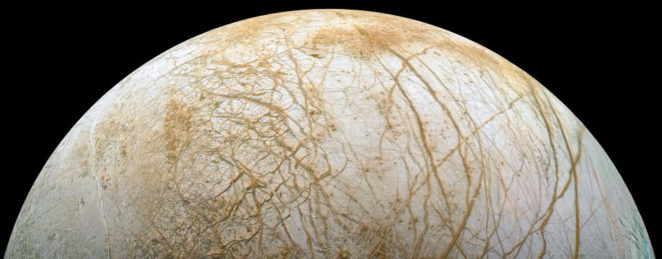
From a distance Europa appears to be a smooth, white ball of ice, but a closer view reveals pale markings that criss-cross its surface, and very few impact craters. This suggests that there is a constant renewal process at work.

Europa is subject to tidal pressures caused by the gravitational pulls of Jupiter and the neighbouring moons of Io and Ganymede. This leads to flexing that produces heat, which in turn leads to the presence of liquid water that is trapped between a rocky core and a crust of ice.

Where the crust fractures, jets of water escape in high arcs that freeze when they hit the surface.

It is quite possible that undersea volcanoes pump chemicals into the oceans and this could lead to the creation of the building blocks of life, which is how many scientists think life began on Earth.

There is therefore the intriguing possibility that Europa harbours living organisms of some kind. Should this be so, the fact that two bodies in our Solar System are life-bearing must make it almost certain that there is life on planets that orbit other stars that are relatively close to our Sun.

In Greek mythology Europa was a high-born woman who was abducted by Zeus in the form of a white bull. She then gave birth to King Minos of Crete. The continent of Europe takes its name from her.
© John Welford

Monday, 29 June 2020

Mercury: closest planet to the Sun


Mercury is the closest planet to the Sun and is also the smallest of the currently recognised planets, now that Pluto has been demoted from planetary status. It is therefore difficult to see, and attempts to do so should be made with the greatest care, as training a telescope in the direction of the Sun is a very unwise thing to do. It is best observed at dawn or dusk, but only if you really know what you are doing. If it’s any consolation, Copernicus never managed to see it, although its existence had been known about since classical times.

Mercury orbits the Sun at an average distance of 58 million kilometres (36 million miles). It completes an orbit every 88 days at a speed of 50Km a second, which is the fastest of any of the planets. This is why Mercury has the name that it does, Mercury being the swift-winged messenger of the gods in Roman mythology.

Mercury revolves on its axis three times for every two orbits round the Sun. This means that a day on Mercury is not much shorter than a Mercury year, and lasts for 59 Earth days.

The surface of Mercury is deeply cratered but it also has some smooth plains. This suggests that the planet was volcanically active at one time, but that this activity ceased a long time ago and meteor impacts have pockmarked most of the surface. Mercury appears to have cooled down and may have shrunk in size as it has done so. The fact that a magnetic field has been detected suggests that it still has a molten core.

Daytime temperatures on Mercury are extremely high, at around 350 degrees Celsius, due to the planet’s proximity to the Sun and the fact that it only has a very thin atmosphere. However, the nights are long enough for the temperature to drop as low as minus 170 degrees Celsius. Mercury does not have a tilted axis, unlike Earth, and therefore has no seasons. This also leaves open the possibility that there could be water on Mercury, existing as ice deep within polar craters into which the Sun never shines.

The atmosphere mentioned above is only as dense as the very outer reaches of Earth’s atmosphere. It comprises mainly helium, hydrogen and oxygen, but traces of potassium and sodium have also been discovered. Although atoms of these elements are constantly being lost into space, they are replaced by the action of Mercury’s magnetosphere in capturing ions from the solar wind that batters the planet.


© John Welford

Tuesday, 23 June 2020

Let's hear it for Quaoar and Weywot!


The Solar System contains a whole host of objects that most people have never heard of. New asteroids are being discovered and named on a seemingly regular basis, and then there are even more in the far reaches of the Solar System way beyond the planet Neptune.

Two such trans-Neptunian objects that not many people know about are Quaoar and Weywot. Quaoar is a dwarf planet and Weywot is its moon.

Quaoar was discovered in 2002 by two astronomers at the California Institute of Technology, namely Chad Trujillo and Michael Brown - and they have many other such discoveries to their credit. Weywot was discovered in 2007, also by Michael Brown.

With such small objects at such a huge distance from Earth, it is hardly surprising that details about them are sketchy, but it is reckoned that Quaoar is about half the size of Pluto, which was demoted to "minor planet" status in 2006. Weywot is a tiny object that is probably only about 75 kilometres across and may be a fragment left over from a collision between Quaoar and a larger body.

The names Quaoar and Weywot come from the religion of the Tongva who are the native people of the Los Angeles region. Quaoar is their creator god and Weywot is his son and the sky god.


© John Welford

Sunday, 21 June 2020

Pioneer X heads for the stars


On 2nd March 1972 Pioneer X was launched from Cape Canaveral in Florida, on a mission to Jupiter and beyond. It was the first outer-planetary probe, the earlier Pioneer missions having been aimed mainly at measuring the solar wind.

Pioneer X travelled 620 million miles in 21 months, at an average speed of 44,000 miles an hour. On 3rd December 1973 it was able to send back the first close-up images ever seen of Jupiter, before heading further afield.

On 13 June 1983 Pioneer X passed Neptune and its course then took it out of the Solar System altogether, with its mission regarded as being complete by 1997, although signals were still being received up until January 2003, more than 30 years after its launch.

Pioneer X was the most distant man-made object from the Sun until 17th February 1997, when this honour was usurped by Voyager I, launched in 1977.

It was always anticipated that Pioneer X would keep heading out into deep space, with the possibility that – at a time far into the future – it might enter another solar system and be found by an intelligent life-form. For that reason, a plaque was attached to the craft that would tell any finder of it where it had come from and what sort of creatures had sent it. These include coordinates and a diagram of our Solar System, plus images of male and female specimens of Homo sapiens.

A similar plaque was attached to Pioneer XI, which was launched in April 1973 and flew past Jupiter and Saturn before also heading into deep space.

The two Voyager missions, launched in 1977, have also left the Solar System, and the New Horizons probe that was launched in 2006 and is still on course for the Kuiper Belt beyond Pluto, will also do so.

Pioneer X is heading in the direction of 10-Tau, a star in the Taurus constellation that is about 45 light years from Earth. However, even if the plaque does get to be seen by an alien intelligence, this will not happen for at least another 36,000 years!

© John Welford