Sunday, 28 June 2020

The Ambassadors, by Hans Holbein


The Ambassadors, by Hans Holbein the Younger (1497-1543) may on the face of it appear to be a magnificent near-life-size double portrait, but closer inspection reveals a whole host of hidden messages.

Hans Holbein, born in Augsburg, was the son of an artist and he was therefore able to develop his skills from an early age. He spent some years working as a professional artist in Basel before arriving in England, initially at the invitation of Sir Thomas More. In 1536 he became court painter to King Henry VIII, and it is Holbein’s portraits of Henry and his circle that come to mind today when we think about that era.

However, Holbein spent some years actively trying to get himself noticed, and The Ambassadors was one of the show pieces, painted in 1533, that he hoped would do the job.

The ambassadors in question were Jean de Dinteville, the French ambassador in London, and Georges de Selve, the Bishop of Lavaur in southern France who also performed diplomatic duties. The two men were friends, and it is possible that Dinteville had asked Holbein to include de Selve in the portrait as he was paying a visit to London at the time. Both men were in their 20s, and had done very well for themselves at a young age.

They are portrayed standing proudly, either side of a display stand (with a lower shelf) on which a number of objects have been placed. The men rest an arm each on top of the stand, thus signifying their ownership of the objects and what they stand for.

Dinteville, on the left as we look, stands with feet apart and wears a robe that is trimmed with a copious quantity of fur, on top of a shirt made from the finest silk. He may not be particularly tall, but he has broad shoulders and appears to be powerful in more ways than one. In later years Holbein was to portray King Henry in a similar pose.

The bishop appears to be dressed more modestly, in a full-length brown robe that he holds closed with one hand. This would have been appropriate dress for a bishop, but it is also clear that this is by no means a cheap robe, as it too is made from thick fur and intricately patterned.

The objects with which the two men are associated are designed to indicate their depth of knowledge and their interest in matters of science and art as well as of worldly affairs and religion. There are therefore a terrestrial and a celestial globe, mathematical and navigational instruments, a lute, several books, and various other bits and pieces.

The detail of these objects is fascinating, because virtually all of them have a secondary meaning that might quite possibly have escaped the notice of the subjects of the portrait. For example, the mathematical instruments show the exact time that the portrait is intended to capture, namely 10.30 am on 11th April. Time has been frozen, thus symbolising that the opulence enjoyed by these men is only of the moment and what the future holds may be very different. A string on the lute is broken, which is a symbol of disharmony as the lute cannot now be played.

One wonders whether the Catholic bishop ever noticed that the open hymnal next to the lute was a German protestant one, containing hymns written by Martin Luther, the arch-enemy of Catholicism?

Holbein had, some eight to ten years previously, completed a set of woodcuts on the theme of the “Dance of Death” in which a number of figures representing all strata of society are seen to be accompanied by a skeleton who symbolises Death. The clear message is that Death comes for us all, from the ploughman to the Pope, and we would all do well to remember this.

In The Ambassadors, there are a number of “memento mori”, most of them quite subtle, but one of them not subtle at all. On the extreme left of the painting, a crucifix hangs on the wall. It is hard to spot, but it is there none the less. Dinteville proudly wears the Order of St Michael around his neck, but on his hat is a badge decorated with a skull.

However, the object that is impossible to miss, and which is the greatest talking point of this remarkable painting, is spread diagonally across the foreground, linking the feet of the two men. Centrally placed, its length is about half the width of the canvas, but it is quite narrow and the observer cannot see what it is supposed to be.

That is, unless they stand to one side (the right) and look again! The object then resolves itself into a skull and we are back to the “Dance of Death”. It cannot be missed and, if the painting had been hung on a staircase as has been surmised was originally intended, the owner would have had this reminder of his mortality every time he glanced sideways at it as he descended to start his day’s work.

(Another suggestion that has been made is that the name Holbein means “skull” in the artist’s local German dialect, and that this is therefore his signature, but this does sound a little far-fetched).

One wonders if Holbein really had a lot of time for his patron when he was painting this work. He clearly went to an enormous amount of trouble to put in so much detail, and that alone would have impressed anyone who was looking around for a candidate to be the next court painter. However, what did Dinteville make of it? Did he get the message that he wasn’t regarded by the artist as being as wonderful as he clearly considered himself to be? Those sideways glances on the staircase must surely have told him something!

The painting is housed in the National Gallery, London.


© John Welford

Saturday, 27 June 2020

Tabby's Star and a possible ringed planet


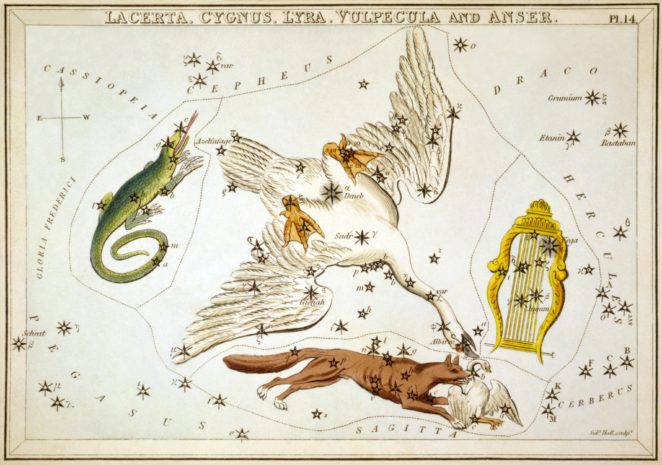
You may well have heard of Barnard’s Star, or possibly even Plaskett’s Star, but Tabby’s Star? Its less memorable name is KIC 8462852. It is an F-type main sequence star that is slightly larger and slightly hotter than our G-type Sun. It is about 1,280 light years away from us, in the Cygnus constellation.

Its name derives from Tabetha Boyajian, an American astronomer who has been leading a team studying the star as part of a general search for planets in orbit around distant stars, based on evidence derived from the Kepler Space Observatory. Tabby’s Star has also been called Boyajian’s Star, although that does sound a bit less friendly!

The reason why Tabby’s Star has excited interest is that its “light curve” (an analysis of the light coming from a star over a period of time) was not what was expected. The search for exoplanets depends on finding light curves that indicate that a planet is passing in front of its star. The light will dim for a period of time then return to normal after the planet’s transit has ceased. This pattern will repeat every time the planet orbits the star, and consistent data taken over a number of years will enable astronomers to calculate the planet’s size, mass and distance from its star.

However, the data from Tabby’s star was all wrong. The dimming that was observed was far from regular and was unpredictable, leading to all sorts of speculation, including the idea that this was evidence of the work of an alien civilization on the planet that had built a vast structure to control the energy being received from its star.

One theory – advanced by a team of astronomers in Colombia – dispenses with the aliens but proposes an explanation that is just as intriguing, namely that the planet in question is similar to Saturn in that it is surrounded by rings.

The theory begins with the notion that a ringed planet, when transiting its star, would produce different intensities of dimming – less when only the ring was in transit, more as the full disc of the planet moved across, and then less again as the “back end” of the ring was all that was obstructing the star’s light. On each transit the degree of dimming might change if the angle of the ring was not the same – the planet may well not rotate in the same plane as its orbit, as we know full well from the behaviour of our own planets. It would probably take many orbits before a consistent pattern could be deduced.

The Colombian astronomers modelled this theory based on the supposed mass of the planet and its closeness to Tabby’s Star, estimated at about one tenth the distance of Earth to the Sun. They found that the star would have a gravitational tug on the rings, causing them to wobble and producing even more irregularity to the light curve.

So the mystery of Tabby’s Star may have been solved. There is no need to imagine a vast engineering project on the part of an advanced alien civilization. All that is needed for the observed phenomena – it appears – is a ringed planet the size of Neptune orbiting close to Tabby’s Star.

However, the jury is still out because this is not the only theory that has been put forward to explain the mystery of Tabby’s Star.

© John Welford

Galileo's troublesome telescope


It is generally known that Galileo Galilei (1564-1642) got into serious trouble with the Vatican when he supported the heliocentric theory of the Solar System that had been advocated by Nicholas Copernicus. What is not so well appreciated is the fact that it was the method he used to try to prove his point that caused just as many problems for him as the theory itself.


Galileo and the Telescope

Galileo had a major advantage over Copernicus in that he was able to make use of a piece of technology that had only been developed long after Copernicus (1473-1543) had died. This was the telescope, the development of which into a practical instrument is attributed to Hans Lippershey, a Dutch lens maker.

Galileo seized on this invention with enthusiasm and made some important improvements to it, such that he was able to increase magnification from 3 times to 30 times. This was enough to allow him to gaze at the night sky and make some important discoveries, including four of the moons of Jupiter in 1610.

He also used the telescope as a means of confirming Copernicus's theory that the planets orbited the Sun rather than Planet Earth being the centre of the known Universe.

However, there was a problem when it came to dealing with the Church, in terms of demonstrating his discoveries. This was that the telescope was doing something that enabled mere mortals to do things that had not been ordained by Man’s creator. It was acceptable to wear lenses as spectacles, because that was only restoring one’s sight to the level that God had given one, but the telescope went much further than that. Only God was “all seeing”, and to seek to emulate God in this respect was nothing short of heresy.

There were many people at the time who refused to look through a telescope, in the belief that they would commit a sin by so doing. One such example was Cesare Cremonini, a philosopher from Padua who was both a friend and a rival of Galileo. Galileo had used a telescope to prove that there were mountains on the Moon, but his invitation to Cremonini to see this for himself was turned down.

When seen from the point of view of the Church, it has to be admitted that there was some justification for their stance that the telescope deceived mankind and was therefore an instrument of the Devil. Early experiments with telescopes, which were nothing like as powerful or carefully constructed as those used today, did not always produce consistent and trustworthy results.

Galileo’s own observations sometimes told against him in this respect. For example, he claimed that the planet Saturn had two companions, one on either side. However, he was unable to repeat this observation some months later, because the companions had apparently disappeared. What had happened was that his first viewing through his telescope had shown the edges of Saturn’s rings when turned at a certain angle. His later viewing was when the rings were edge-on when seen from Earth and therefore not visible.


Galileo and the Inquisition

When Galileo was called upon by the Inquisition in Rome to recant the views expressed in his “Dialogue Concerning the Two Chief World Systems” he was already off to a poor start. Not only was he committing a heresy by supporting the Copernican view of the Solar System, but he was attempting to prove his point by using an instrument of the Devil, namely the telescope.

At least Galileo escaped the fate of Giordano Bruno, who, was burned at the stake in 1600 for his views, which included the daring suggestion that the Sun was no different from the other stars, only much closer. However, Galileo was banned from publishing any further works, and he spent his remaining years under virtual house arrest summarising his earlier work, particularly in physics and mechanics.

If Galileo had left his telescope at home, might he have avoided being silenced by the Church? This is unlikely, although he could hardly have expected a sympathetic hearing when he appeared before his inquisitors armed with the very instrument that had caused so much trouble. None of them was going to accept any invitation to “see for themselves”.

Galileo must surely have known that he stood no chance of getting his accusers to change their minds, so maybe he decided to go down with all guns blazing, to satisfy himself if nobody else.

© John Welford

Friday, 26 June 2020

Globular star clusters


Globular clusters are spherical clusters of stars that typically contain a few hundreds of thousands of stars, or even as many as a million. They are not galaxies, but are associated with galaxies in that they orbit around the galactic plane in a spherical halo.

About 150 globular clusters have been detected around our own galaxy, at distances of 60,000 light years (or more) from the galactic plane. A few can be detected with the naked eye, looking like faint, fuzzy stars. One of the best-known has been given the designation M13 (pictured above) and is visible on summer evenings in the constellation of Hercules. Seen through binoculars it has the appearance of a mothball, and it is only when seen through a large telescope that its true nature is revealed. The best images have come from the Hubble Space Telescope which has shown it to be a whirling mass of tightly packed stars.


Density

However, although the density of stars towards the centre of a globular cluster is up to 100 times greater than in our own region of space, that does not mean that the stars are constantly crashing into each other. If you fired a gun at a point near a cluster’s centre, the chance of hitting a star would be less than 10 to the power of 11 (i.e. 1 with 11 zeroes following, which is 100 billion) to one.

Seen another way, if you lived on a planet that circled a star at the heart of a globular cluster, the other stars would appear as points of light just as neighbouring stars do to us on Planet Earth. They would be light months away as opposed to light years, and there would be many more of them, but they would be points of light nonetheless. The night sky would always have a glow to it, similar to that of faint moonlight on Earth, because of the thousands of stars in the sky that would make it extremely difficult to see any objects that did not belong to the cluster. A Hubble telescope in orbit round our fictional planet would have a much harder task in aiding our understanding of the Universe than the real one does!


Age

Observations of stars in globular clusters show that they are very old, and that the clusters would have formed between 12 and 20 billion years ago, which predates the age of the Milky Way (our own galaxy). Their orbits tend to be highly elliptical and not in the same plane as the galaxy. Such an orbit is therefore similar to that of a comet within our own Solar System, and might take as much as 100 million years to complete.

Star ages are determined by calculating their mass, luminosity and temperature, which in turn shows what stage they have reached in their life cycle. Depending on their original mass, stars go through different evolutionary sequences, but a typical process for a star of similar mass to our Sun is for it to turn into a red giant when the hydrogen at its core has been exhausted. Before this point, a Sun-like star is said to be in the “main sequence” of stars which are stable and have plenty of fuel left to continue the thermonuclear reactions that supply their energy output.

At a later stage in a red giant, gravitational collapse may provide the conditions for the helium at the core to ignite, which is termed the “helium flash” stage. A star that has reached this stage will be both smaller and hotter at the surface than a red giant.

Globular clusters are known to be old because they contain no relatively high-mass main sequence stars, these having evolved into red giants. The main sequence has become shorter because many stars have reached the “turnoff point”. There will also be post-helium flash stars, many of which will have started with relatively low mass, and some “blue stragglers” which are stars that are hotter than main sequence stars but have not turned into red giants, possibly because they are gaining hydrogen fuel from a neighbouring star.


Metal poor stars

Another characteristic that typifies members of globular clusters is that they tend to be “metal poor”. This means that their spectra do not reveal the presence of heavy elements which are found within stars such as our Sun. This is believed to be because such elements were created by the supernova explosions of massive ancient stars, the matter from which then condensed to form later star generations. The stars within globular clusters were formed from material that was available when there was no supernova detritus around.

Globular clusters have, in the past, been very difficult to study because of the problem of distinguishing individual stars. However, tools such as Hubble have made this much easier, with the result that astronomers and astrophysicists are now able to learn much more about how the Universe evolved.


© John Welford

How galaxies are classified


Nobody knows how many galaxies there are in the Universe, but astronomers talk in the hundreds of billions, only a tiny fraction of which have been observed from Earth. Between 2000 and 2008, the Sloan Digital Sky Survey produced images of around a million galaxies, and the Hubble Space Telescope has continued to add to that number.

The Galaxy Zoo project is a continuing quest to make sense of this wealth of data on galaxies, primarily by seeking to classify galaxies into various types. By doing this, it is hoped to learn as much as we can about how galaxies form and, as we collect images of galaxies at much greater distances, we can see if there are significant differences between younger and older galaxies, bearing in mind that when we see an object ten billion light years away we are seeing it as it was ten billion years ago.

Galaxies have long been classified according to their shape, with Edwin Hubble himself being the first classifier in the 1920s, although he had a much smaller number of galaxies at his disposal than we have today. He recognised galaxies as being either elliptical, spiral or barred spiral, adding “irregular” as a fourth category.

Galaxy Zoo prefers a split between elliptical, spiral, lenticular and irregular, and these types are explained below. However, it must always be remembered that detecting the shape of a galaxy is not always easy because we see galaxies at every conceivable angle. A spiral is difficult to detect if it is edge-on as we see it.


Elliptical Galaxies

It was once thought that elliptical galaxies were relatively uncommon, but it is now known that they are the commonest type in the universe. This is because they tend to be of low luminosity and are often quite small. It is only as telescopes have improved that more of these have become apparent and it is now appreciated that ellipticals actually outnumber spirals. Elliptical galaxies are generally older than spiral galaxies, with star formation no longer taking place.

There is a huge range of elliptical galaxies in terms of size and shape and also luminosity. Indeed, some giant ellipticals are more luminous than any known spiral.

In terms of shape, ellipticals can be anything from a round ball shape to that of a cigar, with a classification between E0 to E7 being made (E0 is the roundest, E7 the most elongated). However, it is always possible to mistake a cigar-shaped galaxy seen end-on for a small ball-shaped galaxy.

Sizes range from giant to dwarf, with dwarves probably being the most common type of all galaxies. However, even a dwarf galaxy probably contains several million stars.

Another distinction is made according to whether the galaxy has a pronounced box or disk shape in the central area. Whether an elliptical galaxy is boxy or disky has to do with the movements of stars within the galaxy.


Spiral Galaxies

Spiral galaxies are among the most impressive objects in the Universe, comprising a central bulging core with high star density, and arms of stars spiralling out from the core, demonstrating that the whole galaxy is rotating like a slow Catherine wheel. The arms usually contain a mixture of old and young stars, with clusters of older stars and areas of nebulosity that indicate actual or potential star factories. Star density in the spirals is much less than towards the centre. Our own Milky Way is a spiral galaxy, with the Sun being a star on a spur of one of the spiral arms.

Spiral galaxies typically contain 100 billion stars and measure 100,000 light years in diameter. They may be associated with smaller galaxies and have globular clusters orbiting around them.

There are many variations in spiral galaxies. One important variant is the barred spiral, where the core resembles a bar rather than a disc. The arms begin at the two ends of the bar.

It is also of interest whether the galaxy is rotating in a clockwise or anti-clockwise direction, how many spiral arms there are (anything from one to four or more), and how tightly wound the arms are.

Edwin Hubble classified spiral galaxies as Sa, Sb or Sc, depending on the size of the central bulge and the tightness of the spirals. Fortunately, you do not get a large bulge together with a loose spiral or a tight spiral with a small bulge, so the classifications are generally safe. Sa indicates the tightest spiral and Sc the loosest. Hubble also classified barred spirals in the same way, from Sba to Sbc.


Lenticular Galaxies

These can be thought of as transitional between spiral and elliptical galaxies, and some astronomers maintain that spiral galaxies gradually evolve into ellipticals, becoming lenticular along the way. The theory is that star formation takes place in areas of dust and gas within the spiral arms, and when this is used up and absorbed into stars the spirals become tighter and tighter until they disappear altogether.

A lenticular galaxy therefore has a central disc, which appears as a bulge when seen from the side, and residual arms that are so close to the core that they have ceased to be spirals.


Irregular Galaxies

Any galaxy that does not fit into one of the above patterns is termed “irregular”, and this applies to about 3% of known galaxies. The Milky Way has two companion irregular galaxies that are known as the Large and Small Magellanic Clouds, these being visible with the naked eye from the Southern Hemisphere. They have no definite structure, comprising vast areas of nebulosity in which newly created stars can be detected.

However, it would be wrong to state that all irregular galaxies fit this pattern because there are many that clearly do not. For example, not all of them show signs of star formation. It is possible that some irregular galaxies are the result of collisions between galaxies, or are the scene of multiple supernova events or have come about due to black hole activity. There is much still to be learned here.


Other Ways of Typifying Galaxies

Mention is often made of objects such as quasars, Seyfert galaxies and N-type galaxies. These are galaxies that emit very strong radiation in the non-visible parts of the spectrum, such as radio, X-ray, ultraviolet or infrared. These have raised questions about the presence of black holes at the hearts of galaxies and the occurrence of extremely violent events in the depths of space.

Suffice it to say that the constant discovery of “new” galaxies presents more questions than answers, as there are clearly processes at work that astrophysics continues to try to understand. However, being able to classify galaxies is a very helpful first stage in getting to grips with these mysteries.


© John Welford